
The world needs the masculine man and not just any man but good masculine men.
For a long time society stood on the backs of men.
Manly Men went to war. Men led in politics. Men led at home. Masculine Men lead in the Church but as of recent, men are failing to be what men have always been because of a pervasive culture of the fantasy and effeminacy which is you foregoing the right thing because you're fearful or you don't want to go through hardship.
Manly Men Don't Run From Hardship
Men need courage to stand up and be MEN. One of the reasons why men have muscles and they have a strong emotional stability is so that they can go through hardship and struggles. That's the man's God-given design.
But modern society has been trying to transform man into everything but his design; into everything but enduring hardship; into everything but suffering for the cause of good. But that is man's design.
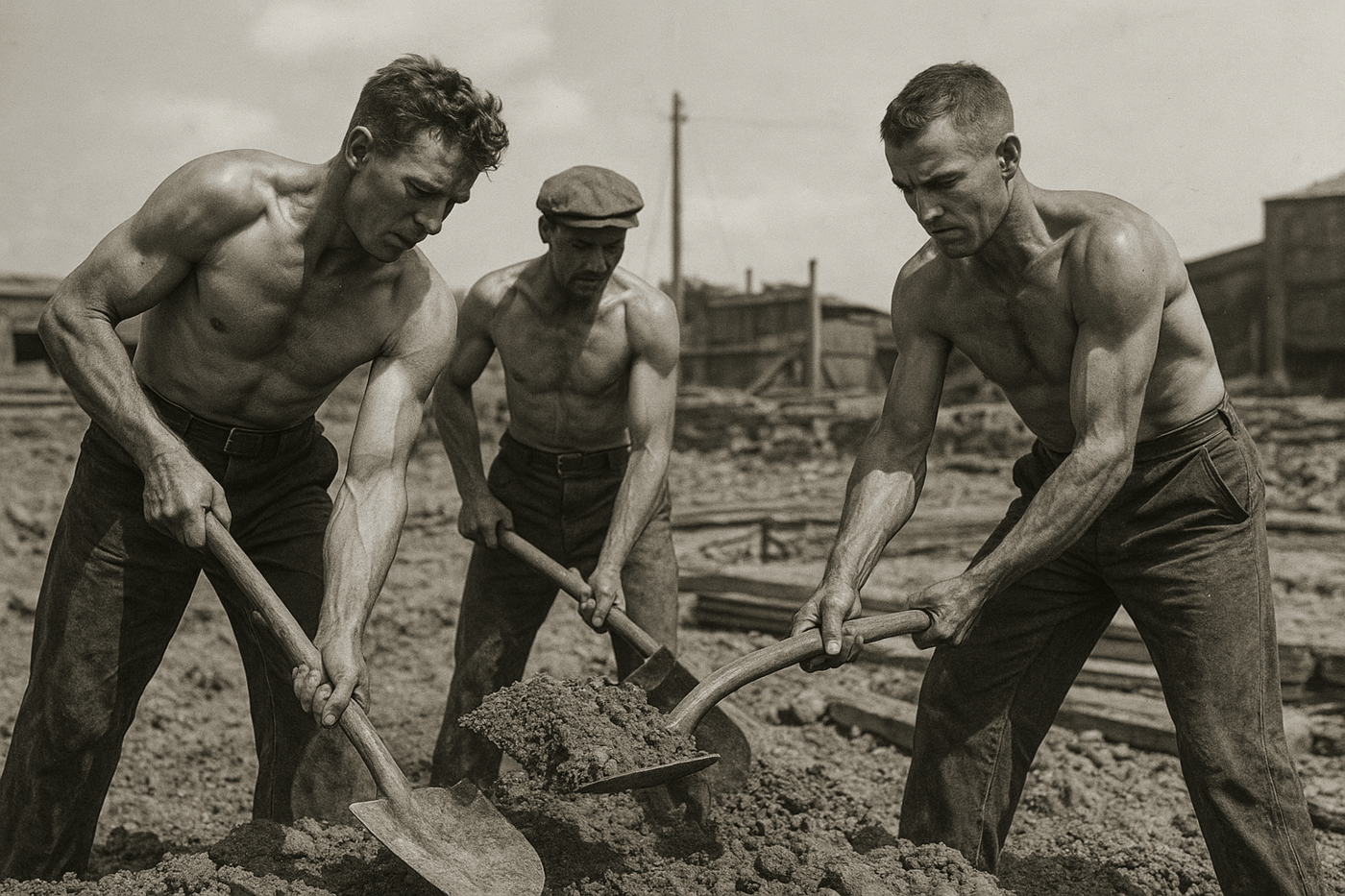
From the very beginning, God created man to tend and to keep and to bear rule man has to understand that hardship is necessary if things are to be molded, and protected.
Men must function a certain way to ensure the safety, survival and success of the human race and the creation itself.
But man has relegated this role in many ways to created structures, abdicating their role as men in society, but this has to change, and it has to change right now. (This gives rise to the importance of male friendships)
The Man Is Needed In The Home
If we're going to have a society that serves God and does what God wants the society to do, then the godly man must stand up. Men must be men in society, for God's will to be done.
No, I've looked at some studies and statistics and I will leave the link here on the differences in single parent households so you can see those. One of the shocking things that I learned is that children from single father households fare better than children from single mother households.
And somebody asks, Why is that I father the mother is more nurturing. I thought that the child is better off with the mother if in the case that there's not father and mother, but the statistics do not bear that.
One of the reasons for this is the man's design. His design is to tend and keep the will of design is to help the man for design is not to attend and keep her children. Her design is to help the man and in seduce to help the children but to direct assignment of the woman is for the man.
It's not the place of women to be pastors in the Church, or to assume headship in the home.
The Manly Men Understand That Roles Are Necessary
The man's assignment is for the entire creation and this is why the single father household is better. God built the man for the entire creation with global, overseeing talents whereas God built the woman for the man and when we stray away from the design of God, for the design of man and woman, we cause irreparable harm to ourselves and societies. This is always the case when we have people doing things that they are not designed by God to do.
No two birds are alike. Neither can a man replace a woman or a woman replace a man. A man cannot give birth to children. A man's mind does not function in the multi-directional way that a woman's mind functions.
God created us differently and we must respect His design if we are to have functioning and productive societies.
But the issue with us as human beings is we want to do it our way. And again, this is why we ended up in the fall in the first place - we try to do life our way as opposed to the way that God said to do it.
Here are the benefits of men staying in their God-given role:
| Benefit of Masculinity | Explanation (Biblical, Psychological, Scientific) |
|---|---|
| 1. Protection & Courage | Scripture identifies masculine strength as protective (Prov. 20:29). Studies in evolutionary psychology show men score higher in risk-taking and physical protection tendencies, linked to testosterone’s effect on threat-response systems. |
| 2. Leadership & Responsibility | The Bible emphasizes male leadership rooted in service (1 Cor. 16:13; Eph. 5:25). Sociological studies show communities with responsible male leadership have lower crime rates, greater family stability, and improved child well-being. |
| 3. Vision, Mission & Purpose | Masculinity pushes men toward mission (Gen. 2:15). Research in motivational psychology shows men tend to thrive when given defined roles, goals, and responsibilities. Masculine purpose orientation increases resilience and reduces depression. |
| 4. Sacrifice & Provision | Biblically, the masculine call is to provide and sacrifice (1 Tim. 5:8). Behavioral economics notes that men derive identity from being contributors. Providing increases male life-satisfaction and lowers stress biomarkers. |
| 5. Strength Under Pressure | “Be strong and act like a man” (1 Kings 2:2). Testosterone enhances stress-resistance, assertiveness, and ability to endure hardship. Studies show men in strength-cultivating environments (sports, physical labor, discipline) show lower anxiety. |
| 6. Emotional Stability & Stoicism | Healthy stoicism is supported biblically (Prov. 16:32). Men tend to compartmentalize stress more effectively. Studies from Harvard show that masculine emotional regulation decreases impulsive decision-making and increases problem-solving clarity. |
| 7. Justice, Conviction & Moral Backbone | Masculine orientation toward justice appears in Scripture (Mic. 6:8; Ps. 82:3–4). Neuroscience suggests men show higher activation in areas tied to rule-based reasoning, which strengthens moral conviction and resistance to manipulation. |
| 8. Building & Creation | Adam’s first mandate involved building and cultivating (Gen. 2:15). Anthropological data show men naturally dominate roles in construction, engineering, and innovation. Masculine drive toward structure produces societal stability. |
| 9. Competitiveness & Growth | God designed men to sharpen one another (Prov. 27:17). Competition increases dopamine-driven learning and performance. Studies show competitive environments improve male productivity, discipline, and skill-mastery. |
| 10. Resilience & Perseverance | Paul’s teachings on endurance align with masculine resilience (1 Cor. 16:13; 1 Tim. 6:12). Sports psychology demonstrates that men show stronger focus on long-term gain over short-term comfort, enhancing grit. |
| 11. Risk-Taking for the Good | Masculinity includes noble risk (David vs. Goliath). Neurobiological research links male risk profiles to societal progress-exploration, invention, and entrepreneurship. |
| 12. Identity & Confidence | Biblically, manhood is tied to identity in God. Masculine confidence increases when responsibility is taken. Psychology notes that achievement + discipline → healthy self-respect and decreased depression. |
| 13. Capability to Defend Truth | Jude 1:3 calls believers to contend for the faith. Masculine mindset steels men to defend doctrine, family, and community. Studies show men excel in confrontation-based conflict resolution. |
| 14. Physical Strength & Health | Physical strength is praised (Prov. 20:29). Strength training increases testosterone, reduces anxiety, increases cognitive clarity, and boosts lifespan. |
| 15. Stability for Families & Communities | Masculine presence lowers poverty, increases academic achievement for children, and reduces crime. Scripture presents manhood as the stabilizing spine of families (Ps. 128; Eph. 6). |
The Scriptures are clear that the man is the head of the wife, and Christ is the head of every man and as such, the men should lead the women. The men should be leaders in The Church and society so that our societies can be run with people that are not only capable of running the society, but also designed by God to run the society.
The masculine man is very much needed in our society and my prayer is that good men will rise to the occasion to tend and keep in Jesus' Name.
References:
Biblical & Theological Sources
Bruce, F. F. The Epistles to the Corinthians. Eerdmans, 1971.
Keil, C. F., & Delitzsch, F. Commentary on the Old Testament. Hendrickson, 1866–1890.
Henry, Matthew. Commentary on the Whole Bible. Hendrickson, 1710.
Calvin, John. Commentaries on the Epistles of Paul. Baker, 1556–1559.
Lange, John Peter. Lange’s Commentary on the Holy Scriptures. Zondervan, 1864–1880.
Spurgeon, Charles H. The Treasury of David. 1869–1885.
Edersheim, Alfred. Bible History: Old Testament. Eerdmans, 1876.
Meyer, Heinrich. Critical and Exegetical Commentary on the New Testament. T & T Clark, 1830–1870.
Athanasius. On the Incarnation. 4th Century.
Chrysostom, John. Homilies. 4th Century.
Psychology, Neuroscience & Behavioral Science
Sapolsky, Robert. Behave: The Biology of Humans at Our Best and Worst. Penguin, 2017.
Baumeister, Roy. “The Relative Benefits of Masculine Identity.” Psychological Inquiry 2000.
Dabbs, James. “Testosterone and Social Behavior.” Science 1995.
Archer, John. “Sex Differences in Aggression.” Psychological Bulletin, 2004.
Geary, David. Male, Female: The Evolution of Human Sex Differences. APA Press, 1998.
Taylor, Shelly. “Biobehavioral Responses to Stress.” Psychological Review, 2000.
Kemper, Theodore. Social Structure and Testosterone. Rutgers University Press, 1990.
Mazur, Allan & Booth, Alan. “Testosterone and Dominance.” Behavioral and Brain Sciences, 1998.
Niederle, Muriel & Vesterlund, Lise. “Gender and Competition.” Quarterly Journal of Economics, 2007.
Gavrilets, Sergey. “The Evolution of Risk-Taking.” PNAS, 2014.
Sociology, Family Studies & Community Strength
Wilcox, W. Bradford. Soft Patriarchs, New Men: How Christianity Shapes Fathers and Husbands. University of Chicago Press, 2004.
Popenoe, David. “The Decline of Fatherhood.” Society, 1996.
Lamb, Michael (ed.). The Role of the Father in Child Development. Wiley, 2010.
Blankenhorn, David. Fatherless America. HarperCollins, 1995.
McLanahan, Sara & Sandefur, Gary. Growing Up with a Single Parent. Harvard University Press, 1994.
Putnam, Robert. Bowling Alone: The Collapse and Revival of American Community. Simon & Schuster, 2000.
Samson, Kim. “Male Leadership Roles and Community Stability.” Journal of Social Structure, 2011.
Fagan, Patrick. “Father Absence and Societal Breakdown.” Marriage & Family Review, 1999.
Anthropology, Evolutionary Science & Human Development
Wrangham, Richard. Demonic Males. Houghton Mifflin, 1996.
Tooby, John & Cosmides, Leda. “The Psychological Foundations of Culture.” Oxford Handbook of Evolutionary Psychology, 2005.
Ellis, Bruce. “Male Development and Risk Profiles.” Developmental Psychology, 2004.
Hawkes, Kristen. “Provisioning Behavior and Male Role Evolution.” Human Nature, 1992.
Kaplan, Hillard. “Risk, Provisioning, and Male Life Strategy.” Evolutionary Anthropology, 2009.
Men’s Health, Strength & Biological Resilience
Faigenbaum, Avery. “Resistance Training for Men’s Health.” Sports Medicine, 2009.
Kraemer, William. “Testosterone Responses to Strength Training.” Journal of Applied Physiology, 1998.
Rantanen, Taina. “Muscle Strength and Longevity.” Journal of Gerontology, 1999.
Hogan, Martin. “Physical Strength as a Predictor of Psychological Stability.” Psychophysiology, 2010.
Snyder, Edward. “Strength Training and Mental Health.” Journal of Strength & Conditioning Research, 2011.
Moral Reasoning, Justice & Conviction
Kohlberg, Lawrence. Essays on Moral Development. Harper & Row, 1981.
Hauser, Marc. Moral Minds. HarperCollins, 2006.
Rest, James. “Moral Judgment Theory.” Developmental Review, 1986.
Piazza, Jared. “Gender Differences in Moral Conviction.” Personality and Social Psychology Bulletin, 2012.