
Table of Contents
- Therefore, man is powerful and wise.
- My Favorite Bible Verses About Manhood
- Biblical & Theological Sources
- Wisdom, Masculinity, Virtue & Character Development
- Strength, Physiology & Male Biology
- Neuroscience, Discipline, Stress & Emotional Regulation
- Psychology of Wisdom, Discernment & Moral Reasoning
- Masculinity, Responsibility & Virtue Shaping
- Christian Formation, Wisdom, and Character-Building
What does biblical manhood look like for the Christian man? Biblical manhood for the Christian man entails being powerful physically and spiritually.
Now when we look at the effects of testosterone in the body, we know that testosterone affects the muscles and the physical body in terms of the strength, power and the size of your muscles, but it also affects your mind and the way that your brain develops. And so this hormone, which is central to masculinity, both affects the body in terms of how physically intimidating or powerful it is, and the brain and how powerful that is. This is God's design for the man.
| Aspect of Manly Strength | View |
|---|---|
| 1. God-Designed Strength for Men | Scripture teaches that “the glory of young men is their strength” (Prov. 20:29). Physical strength is not prideful-it is God-given capacity for service, defense, and labor. |
| 2. Strength as Stewardship | The body is a temple (1 Cor. 6:19–20), and developing strength is stewardship of God’s gift. Manly strength enables work, protects family, and increases endurance. |
| 3. Strength Enables Masculine Roles | Provision, protection, building, and leadership all require energy and physical capability. Historical societies depended on strong men to maintain stability. |
| 4. Hormonal Support for Strength | Testosterone supports muscle growth, bone density, and assertive energy. Training amplifies these natural male advantages and stabilizes mood. |
| 5. Progressive Resistance Training | Muscle is built through overload-lifting weights, calisthenics, and manual labor. Discipline in training produces both physical and spiritual perseverance. |
| 6. Protein Intake for Muscle Growth | Adequate protein supports recovery, strength, and testosterone production. Studies show frequent protein servings increase muscle mass and reduce fat. |
| 7. Strength Reduces Stress & Anxiety | Strength training lowers cortisol and improves emotional resilience. Men who build strength also build psychological stability. |
| 8. Strength & Purpose | Men with strong bodies often report stronger identity and purpose. Physical discipline spills over into spiritual and mental endurance. |
| 9. Combatting Laziness & Passivity | Physical training teaches self-control and responsibility. Scripture warns men against sloth (Prov. 6:9–11), encouraging active, disciplined bodies. |
| 10. Strength for Kingdom Work | Many biblical assignments were physically demanding-Noah building the ark, David fighting battles, Paul’s missionary journeys. Physical strength supports spiritual calling. |
| 11. Strength Enhances Longevity | Studies show stronger men live longer and remain functional later in life. Muscle mass protects joints, metabolism, and cardiovascular health. |
| 12. Strength & Family Security | Physically strong men provide a sense of safety and stability. Children and wives draw comfort from a man who is capable and protective. |
| 13. Strength as Male Bonding | Men train, compete, and sharpen one another through physical challenge (Prov. 27:17). Shared physical struggle builds brotherhood and accountability. |
| 14. Strong Body, Strong Mind | Exercise increases dopamine and improves focus and discipline. Men who train regularly think more clearly and handle conflict better. |
| 15. Overcoming Weakness & Excuses | Building strength requires conquering mental resistance. Every disciplined workout strengthens both body and will. |
Your focus, intellectual prowess and all of that is attributed to testosterone as well. And we see evidence of this in Scripture, where Christ, who is the last Adam, the last man, is said to be the power and wisdom of God.
Therefore, man is powerful and wise.
The strength or power in the mind brings about wisdom. This is why I mentioned in the beginning, that a man is to be strong physically and spiritually.
| Aspect of Manly Wisdom | View (Biblical + Practical Insight) |
|---|---|
| 1. Fear of the Lord | Scripture teaches that “the fear of the LORD is the beginning of wisdom” (Prov. 9:10). A man who reverences God gains clarity, discernment, and direction. |
| 2. Self-Control | Wise men rule their spirits (Prov. 25:28). Restraint in emotion, appetite, and reaction is central to masculine maturity. |
| 3. Discernment | A wise man can judge motives, detect deception, and recognize spiritual danger. Discernment protects a man and those he leads. |
| 4. Patience & Slow Anger | Scripture calls the patient man “better than the mighty” (Prov. 16:32). Self-governing calmness is a mark of masculine wisdom and strength. |
| 5. Counsel & Teachability | Wise men seek counsel and correction. Humility keeps a man from destruction and opens the door to growth. |
| 6. Stewardship of Words | A wise man speaks with purpose, clarity, and restraint (Prov. 17:27). His words build, heal, correct, and lead. |
| 7. Strategic Thinking | Wisdom empowers men to plan, calculate consequences, and act with foresight. Scripture calls this prudence and knowledge of the times. |
| 8. Responsibility & Duty | A wise man accepts responsibility for his life, choices, family, and purpose. Rejecting blame-shifting strengthens his character. |
| 9. Humility Before God | Humility brings wisdom because it opens the heart to divine truth. Pride blinds, but humility enlightens. |
| 10. Work Ethic | Proverbs honors men who labor diligently and rebukes sloth. A wise man works with excellence, discipline, and integrity. |
| 11. Emotional Stability | Wisdom produces emotional steadiness-measured responses, not impulsive ones. This stability makes a man trustworthy. |
| 12. Moral Purity | Wise men flee sexual immorality and guard their hearts (Prov. 5–7). Purity increases clarity, strength, and divine favor. |
| 13. Ability to Lead | Wisdom equips a man to guide his home, ministry, and work with sound judgment. Leadership flows from righteous decision-making. |
| 14. Courage to Stand Alone | A wise man stands firm in truth even when unpopular. He follows conviction, not crowd pressure. |
| 15. Justice & Fairness | Wisdom teaches men to judge rightly, defend the weak, and uphold righteousness. God honors men who walk in integrity. |
This is what the Christian man must learn.
The Christian man must learn to be physically powerful, meaning not lazy, able to lift weight, physically fit and ready for work and also spiritually powerful, moving in the gifts of the Spirit, listening to the voice of God, being bold and courageous in the things that God wants him to do, and, of course, in the teaching and the building of the Church. The man is to be in the overseer or pastoral position. This is not given to women because of the design of man, which is to tend and keep, or, in other words, to build and protect. Again, testosterone goes hand in hand with this.
What does masculinity look like for the Christian man?
The Christian man is to be physically and spiritually powerful in Jesus' mighty name.
The balance here is that God sets the goal, He determines what you should have, so rest in that godly contentment as a man for it is much gain.
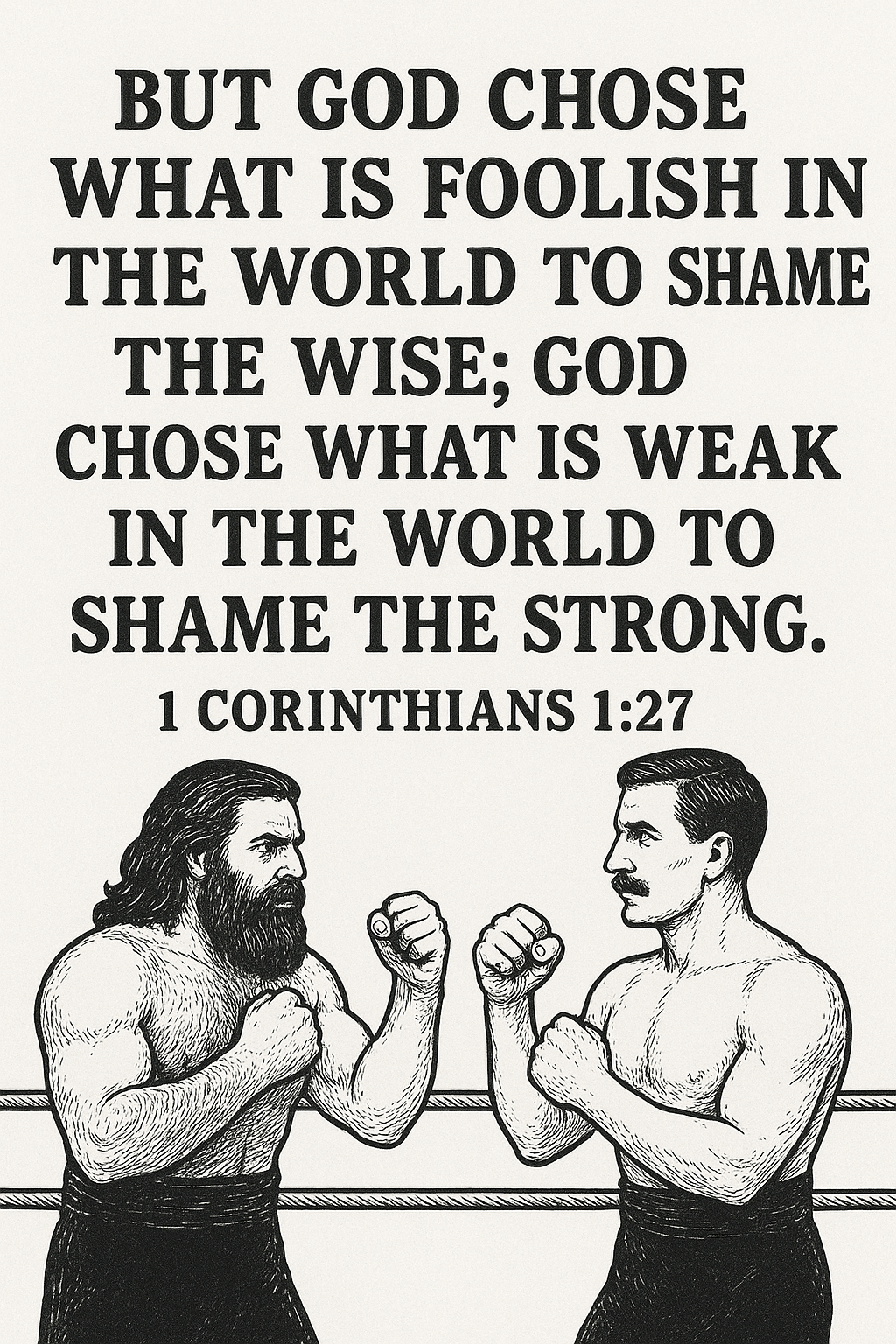 You don't have to be like someone else to be the man that God made you to be. You just have to be submitted to Him for His guidance in your life in living your manhood out.
My Favorite Bible Verses About Manhood
The glory of young men is their strength, And the splendor of old men is their gray head. (Proverbs 20:29)
Be of good courage, and let us play the men for our people, and for the cities of our God: and the LORD do that which seemeth him good. (2 Samuel 10:12)
 References:
Biblical & Theological Sources
Keil, C. F. & Delitzsch, F. Commentary on the Old Testament. Hendrickson, 1866–1890.
Calvin, John. Commentaries on the Epistles of Paul. Baker, 1556–1559.
Henry, Matthew. Commentary on the Whole Bible. 1710.
Chrysostom, John. Homilies on Proverbs and Homilies on Ephesians. 4th Century.
Augustine. On the Good of Marriage; On Patience; On Christian Doctrine. 4th–5th Century.
Athanasius. Letters to Serapion. 4th Century (maturity, discipline, spiritual strength).
Thomas Aquinas. Summa Theologica. 1274 (virtue, prudence, fortitude).
Luther, Martin. The Estate of Marriage; Table Talk. 16th Century.
John Owen. On Temptation. 1658.
Jonathan Edwards. Religious Affections. 1746 (discernment, self-mastery).
Charles Spurgeon. Lectures to My Students. 1875.
Andrew Murray. Humility & Absolute Surrender. 1895.
Dietrich Bonhoeffer. The Cost of Discipleship. SCM Press, 1937.
C. S. Lewis. The Four Loves; Mere Christianity. HarperOne, 1952–1960.
J. I. Packer. Knowing God. InterVarsity Press, 1973 (wisdom, fear of the Lord).
Wisdom, Masculinity, Virtue & Character Development
Aristotle. Nicomachean Ethics. 4th Century BC (virtue, prudence, fortitude).
Willard, Dallas. The Spirit of the Disciplines. HarperOne, 1988 (self-control & formation).
Budziszewski, J. The Revenge of Conscience. Spence Publishing, 1999 (moral wisdom).
Stott, John. The Message of Proverbs. IVP, 1976.
Kidner, Derek. Proverbs: An Introduction and Commentary. Tyndale, 1964.
Bruce Waltke. The Book of Proverbs: Chapters 1–15, 15–31. Eerdmans, 2004.
Tremper Longman III. Proverbs. Baker Academic, 2006 (biblical wisdom literature).
Os Guinness. The Call. Nelson Books, 2003 (purpose & discipline).
Paul David Tripp. Lead: 12 Principles for Leadership. Crossway, 2020 (responsibility & prudence).
Strength, Physiology & Male Biology
Kraemer, William & Ratamess, Nicholas. “Hormonal Responses to Resistance Exercise.” Sports Medicine, 2005.
Phillips, Stuart. “Protein Requirements and Muscle Mass.” Applied Physiology, Nutrition, and Metabolism, 2014.
Rantanen, Taina. “Muscle Strength and Longevity.” Journal of Gerontology, 1999.
Faigenbaum, Avery. “Resistance Training for Health.” Sports Medicine, 2009.
Schoenfeld, Brad. Science and Development of Muscle Hypertrophy. Human Kinetics, 2016.
Häkkinen, Keijo. “Neuromuscular Adaptations to Strength Training.” International Journal of Sports Medicine, 1985.
Herbert, R. & Gabriel, M. “Effects of Strength Training on Muscle.” Journal of Strength & Conditioning, 2002.
Booth, F. & Laye, M. “Protein Synthesis and Resistance Exercise.” Journal of Physiology, 2010.
Archer, John. “Testosterone and Competitiveness.” Behavioral Sciences & Law, 2006.
Neuroscience, Discipline, Stress & Emotional Regulation
Sapolsky, Robert. Behave. Penguin, 2017 (stress, resilience, male biology).
Damasio, Antonio. Descartes’ Error. Penguin, 1994 (emotion, decision-making).
Goleman, Daniel. Emotional Intelligence. Bantam Books, 1995.
Baumeister, Roy & Tierney, John. Willpower: Rediscovering the Greatest Human Strength. Penguin, 2011.
Mischel, Walter. The Marshmallow Test. Little, Brown, 2014 (self-control).
Fredrickson, Barbara. “Resilience and Emotional Regulation.” Journal of Personality, 2004.
Psychology of Wisdom, Discernment & Moral Reasoning
Kahneman, Daniel. Thinking, Fast and Slow. Farrar, Straus and Giroux, 2011 (discernment & cognitive bias).
Peterson, Jordan. 12 Rules for Life. Random House, 2018 (responsibility & masculine discipline).
Erikson, Erik. Childhood and Society. Norton, 1950 (identity & maturity).
Hauser, Marc. Moral Minds. HarperCollins, 2006 (moral discernment).
Masculinity, Responsibility & Virtue Shaping
Wilcox, W. Bradford. Soft Patriarchs, New Men. University of Chicago Press, 2004 (men, leadership, strength).
Popenoe, David. Life Without Father. Harvard University Press, 1996 (role of men in stability).
Geary, David. Male, Female: The Evolution of Human Sex Differences. APA Press, 1998.
Tooby, John & Cosmides, Leda. The Adapted Mind. Oxford University Press, 1992 (male drive & resilience).
Wrangham, Richard & Peterson, Dale. Demonic Males. Houghton Mifflin, 1996 (endurance, risk-taking, male cooperation).
Christian Formation, Wisdom, and Character-Building
Dallas Willard. Renovation of the Heart. NavPress, 2002.
Thomas à Kempis. The Imitation of Christ. 1441 (humility, discipline).
A. W. Tozer. The Pursuit of God. Christian Publications, 1948 (self-mastery).
Richard Foster. Celebration of Discipline. HarperCollins, 1978.
Oswald Chambers. My Utmost for His Highest. 1927 (manly devotion & inner strength).