

Who wrote the book of Mark?
John Mark wrote the book of Mark. He was closely linked with the Apostle Barnabas and was his cousin.
If you recall in Scripture John Mark ran away when times in ministry were tough, and this caused a divide between the Apostles Paul and Barnabas.
But in the latter end of The Apostle Paul's ministry he requested that Mark be sent for, because he was "needful".
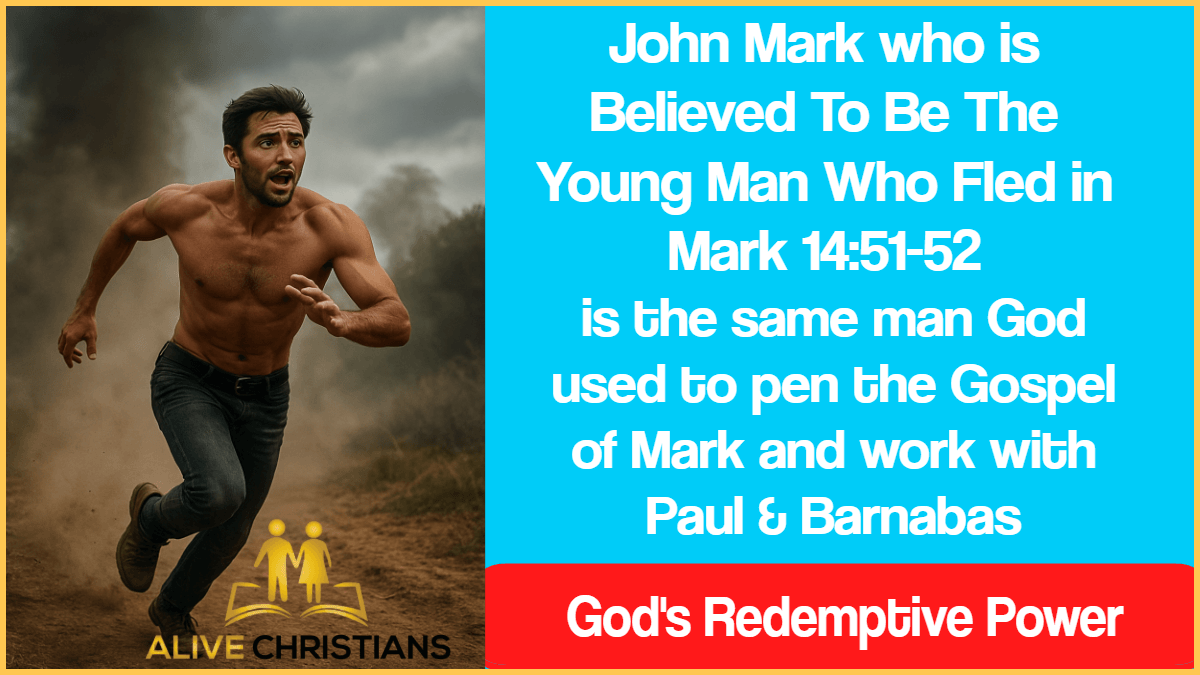
He was also connected very closely to the Apostle Peter who probably knew him from the time before he allegedly (not conclusively) ran away naked at the time of the arrest and crucifixion of the Lord Jesus.
This illustrates the redemptive power of God for all of us, for we are changed to be more like God as we yield to His Holy Spirit.
Church Fathers on John Mark
| Church Father | Quotation or Summary | Context |
|---|---|---|
| Papias of Hierapolis (early 2nd century AD) Source: Fragments preserved in Eusebius, Hist. Eccl. 3.39 | “Mark, having become the interpreter of Peter, wrote down accurately everything that he remembered, without however recording in order what was either said or done by Christ… He took special care not to omit anything he heard, nor to include any false statement.” | The earliest surviving testimony: identifies Mark as Peter’s interpreter and the Gospel of Mark as based on Peter’s preaching. |
| Irenaeus of Lyon (c. 180 AD) Source: Against Heresies III.1.1 | “After their departure [of Peter and Paul], Mark, the disciple and interpreter of Peter, did also hand down to us in writing what had been preached by Peter.” | Asserts apostolic authorship of the four Gospels; affirms the Papian tradition linking Mark to Peter. |
| Clement of Alexandria (late 2nd – early 3rd century AD) Source: Hypotyposeis (fragment in Eusebius Hist. Eccl. 6.14.6–7) | “When Peter had publicly preached the word at Rome, and by the Spirit proclaimed the Gospel, those present, who were many, exhorted Mark, as one who had followed him for a long time and remembered what he had said, to write down what had been spoken; and he composed the Gospel and handed it to those who asked him.” | Describes Mark’s Gospel as a faithful record of Peter’s preaching, written in Rome at the request of Peter’s hearers. |
| Tertullian (c. 200 AD) Source: Against Marcion IV.5 | “That which Mark published may be affirmed to be Peter’s, whose interpreter Mark was.” | Lists the four canonical Gospels and ties Mark’s to Peter’s authority. |
| Origen of Alexandria (c. 230 AD) Source: Commentary on Matthew (I.1, quoted in Eusebius Hist. Eccl. 6.25.5) | “The second [Gospel] is by Mark, who wrote it according to the instructions of Peter, who also acknowledged him as a son in his Epistle.” | Confirms the same Petrine link and authorship sequence among the four Gospels. |
| Eusebius of Caesarea (c. 325 AD) Source: Ecclesiastical History 2.15–16 | Repeats Papias and Clement, adding that Peter approved the reading of Mark’s Gospel in the churches and that Mark founded the church in Alexandria. | Consolidates earlier traditions and connects Mark with both Rome and Alexandria. |
| Jerome (c. 392 AD) Source: De Viris Illustribus 8 | “Mark, the disciple and interpreter of Peter, wrote a short Gospel at the request of the brethren at Rome, relating what he had heard Peter narrate. When Peter heard it, he approved it and gave it to be read in the churches. He also took the Gospel to Egypt and first preached Christ at Alexandria.” | Combines earlier testimonies, presenting the standard Western view: Mark as Peter’s interpreter and founder of the Alexandrian church. |
| Augustine of Hippo (early 5th century AD) Source: De Consensu Evangelistarum I.2.4 | “Mark follows him [Matthew] closely, as it were his attendant and abbreviator.” | Accepts Mark’s Gospel as canonical but views it as a condensed version of Matthew’s; continues traditional authorship line. |
| Theophylact of Ohrid (11th century AD) Source: Prologue to the Gospel of Mark | Repeats that Mark wrote his Gospel in Rome from Peter’s teaching and later preached in Alexandria, where he suffered martyrdom. | Byzantine continuation of the same apostolic tradition. |
Let's look other scriptures on John Mark or John who is called Mark below:
Acts 15:36-41
36 Then after some days Paul said to Barnabas, “Let us now go back and visit our brethren in every city where we have preached the word of the Lord, and see how they are doing.” 37 Now Barnabas was determined to take with them John called Mark. 38 But Paul insisted that they should not take with them the one who had departed from them in Pamphylia, and had not gone with them to the work. 39 Then the contention became so sharp that they parted from one another. And so Barnabas took Mark and sailed to Cyprus; 40 but Paul chose Silas and departed, being [n]commended by the brethren to the grace of God. 41 And he went through Syria and Cilicia, strengthening the churches.
Who was John Mark before he wrote the Gospel of Mark?
For that, we'd have to look at the naked young man in Mark 14:51-52 who fled. Many biblical scholars identify him as John Mark himself. This fleeing behavior is also reminiscent of John Mark's behavior with the Apostle Paul.
| Scholar / Source | Scholarly View |
|---|---|
| Papias (as preserved in Eusebius, Ecclesiastical History) | Papias’ testimony that Mark wrote accurately what he remembered from Peter leads many to infer that Mark occasionally inserted brief autobiographical details into his Gospel.The unusual episode of a young man fleeing naked has no theological necessity, suggesting eyewitness reminiscence. Early tradition holds Mark was a close follower of Peter and present in Jerusalem at the Passion events. This makes the identification plausible, though Papias himself does not explicitly state it. |
| Jerome - Lives of Illustrious Men | Jerome notes that Mark was from Jerusalem and that his mother’s house was a key meeting place for early believers (Acts 12:12), placing him near the events of Jesus’ arrest. His proximity strengthens the likelihood that he was an eyewitness to part of the Passion narrative. The naked flight narrative reads like a personal signature added with modesty. Jerome’s framework supports the idea without directly asserting it. |
| John Lightfoot - Hebrew and Talmudical Exercitations on the Gospels | Lightfoot observes that the detail of a linen cloth (sindōn) implies someone young, wealthy, or from a household with resources-fitting Mark’s family background. He argues that the abruptness and specificity of the passage indicate the writer was describing himself. Lightfoot sees the “runaway youth” as a humble admission of personal fear. This self-referential moment aligns with Mark’s tendency toward vivid detail. |
| Adam Clarke - Clarke’s Commentary | Clarke views the “young man” as almost certainly Mark due to the anonymity and narrative abruptness. He notes that ancient writers often included themselves indirectly in their own accounts. The detail is too unique, too insignificant to the narrative, and too personal to be random. Clarke concludes that this was Mark’s quiet self-recording of his presence. |
| Alfred Edersheim - The Life and Times of Jesus the Messiah | Edersheim connects the location of Gethsemane to the likely residence of Mark’s family, making his appearance there historically probable. He argues that the sudden intrusion of an unnamed youth reflects eyewitness memory. Edersheim also notes that Mark’s Gospel contains several vivid, “insider” moments. This supports the idea that Mark inserted personal experience into the Passion narrative. |
| William Lane - The Gospel According to Mark (NICNT) | Lane sees the account as “autobiographical transparency,” given Mark’s stylistic tendency to include sensory detail. The episode is narratively unnecessary but biographically meaningful. Its presence suggests humility and honesty. Lane identifies Mark as the most likely figure described. |
| R. T. France - The Gospel of Mark (NIGTC) | France argues that the story is too particular and too strange to be symbolic or fictional. He suggests it is best interpreted as a personal recollection of Mark himself. The anonymity is consistent with self-effacing ancient writing practices. France considers the identification strongly probable. |
| C. E. B. Cranfield - The Gospel According to St. Mark | Cranfield notes that the reference to the linen cloth may reflect a hurried departure from a nearby home-again pointing to Mark. He regards the narrative as an eyewitness fragment preserved without embellishment. The personal nature of the event gives it autobiographical character. Cranfield accepts Mark-as-the-young-man as a reasonable conclusion. |
| Brooke Foss Westcott - Introduction to the Study of the Gospels | Westcott sees the insertion as a mark of eyewitness origin, common in early biographies. The event bears no theological weight, making deliberate literary invention unlikely. Westcott considers the simplest explanation that Mark included a personal memory. This fits with his view of Gospel authorship and testimony. |
| F. F. Bruce - The New Testament Documents: Are They Reliable? | Bruce affirms that the details are too particular to be symbolic invention, pointing instead toward eyewitness memory. He argues that the house of Mark’s mother was central to early Christian gatherings, making his presence at Gethsemane likely. The incident aligns with the Gospel’s overall realism. Bruce sees the identification as historically consistent. |
But later we do see the strengthening of Mark, because even though the Apostle Paul at first rejected him as a colaborer in ministry, he later sent for him because he was needful. This shows the redemptive and transformative nature of God's grace in the life of a believer.
Here's the redemption story of Mark with the Apostle Paul:
Timothy 4:10-11 For Demas hath forsaken me, having loved this present world, and is departed unto Thessalonica; Crescens to Galatia, Titus unto Dalmatia.11 Only Luke is with me. Take Mark, and bring him with thee: for he is profitable to me for the ministry.
Salient Words Used in Mark's Gospel:
| Greek Word + Transliteration + Meaning | Reference + Snippet | Scholarly Notes |
|---|---|---|
| εὐθύς - euthys - “immediately, at once” | Mark 1:10 - “…and immediately coming up out of the water…” | The adverb euthys creates Mark’s signature fast-paced narrative movement. It intensifies the sense of divine urgency in Jesus’ ministry. Mark uses it more than any other Gospel writer, shaping the book’s kinetic style. James Hastings, Dictionary of the Bible (1898) notes that its frequency reflects the evangelist’s theological emphasis on decisive action. |
| ἐξουσία - exousia - “authority, right to act” | Mark 1:22 - “…He taught them as one having authority…” | Exousia highlights Jesus’ unique divine prerogative in teaching, healing, and forgiving. Mark contrasts Jesus’ authority with the scribes’ derivative traditions. The word establishes the theme of the Kingdom breaking into human structures. Joseph Henry Thayer, Greek-English Lexicon (1889) affirms its usage denotes inherent, not delegated, authority. |
| μετάνοια - metanoia - “repentance, change of mind” | Mark 1:4 - “…preaching the baptism of repentance…” | Metanoia expresses deep moral and spiritual reversal in response to divine initiative. Mark places this term at the Gospel’s opening to prepare for Jesus’ message. Its semantic field includes both sorrow and transformation. Richard C. Trench, Synonyms of the New Testament (1896) observes that it signifies inward renewal beyond outward ritual. |
| βασιλεία - basileia - “kingdom, reign, rule” | Mark 1:15 - “…the kingdom of God is at hand…” | Basileia in Mark refers primarily to God’s dynamic reign rather than a physical territory. Jesus’ proclamation signals the in-breaking of divine sovereignty. The word frames Mark’s theological architecture. Philip Schaff, Commentary on the New Testament (1882) notes that the term signifies both present reality and future fulfillment. |
| εὐαγγέλιον - euangelion - “good news, gospel” | Mark 1:1 - “The beginning of the gospel of Jesus Christ…” | Euangelion grounds Mark’s narrative as proclamation rather than biography. It signals God’s saving action through Jesus. Mark uses it to anchor his whole theological message. Franz Delitzsch, Biblical Commentary on the New Testament (1884) stresses that the term reflects prophetic fulfillment. |
| πνεῦμα - pneuma - “spirit, breath, Spirit” | Mark 1:12 - “…the Spirit driveth Him into the wilderness…” | Pneuma here emphasizes divine compulsion rather than gentle guidance. Mark’s portrayal of the Spirit is vigorous and active. The word reveals the Spirit’s role in inaugurating Jesus’ mission. B. F. Westcott, The Gospel of the Resurrection (1879) notes its connection to empowerment and divine agency. |
| δαιμόνιον - daimonion - “demon, evil spirit” | Mark 1:23 - “…a man with an unclean spirit…” | Daimonion underscores the cosmic conflict structuring Mark’s early chapters. Jesus confronts spiritual evil as part of His kingdom mission. Exorcisms are central signs of divine authority. James Hastings, Dictionary of the Bible (1898) states that the term indicates personal spiritual intelligences opposed to God. |
| ἄφεσις - aphesis - “forgiveness, release” | Mark 2:5 - “…your sins are forgiven…” | Aphesis expresses liberation from guilt and spiritual bondage. In Mark, forgiveness is tied directly to Jesus’ authority. The word anticipates the cross as the climactic act of release. Joseph Henry Thayer, Greek-English Lexicon (1889) defines it as both legal pardon and spiritual emancipation. |
| σπλαγχνίζομαι - splagchnizomai - “to have compassion, be moved inwardly” | Mark 1:41 - “…Jesus, moved with compassion…” | Splagchnizomai reveals Jesus’ visceral emotional response to human suffering. Mark uses it to show that compassion motivates divine action. The term bridges emotion and miracle. Richard C. Trench, Synonyms of the New Testament (1896) notes its usage implies deep inward movement, not superficial pity. |
| πίστις - pistis - “faith, trust, fidelity” | Mark 5:34 - “…thy faith hath made thee whole…” | Pistis denotes relational trust directed toward Christ. Mark connects faith with healing, deliverance, and salvation. The word marks an essential response to Jesus’ revelation. Philip Schaff, Commentary on the New Testament (1882) affirms that pistis in Mark means trust that acts. |
Reference List:
Joseph Henry Thayer, Greek-English Lexicon of the New Testament (1889)
Richard C. Trench, Synonyms of the New Testament (1896)
Franz Delitzsch, Biblical Commentary on the New Testament (1884)
Philip Schaff, Commentary on the New Testament (1882)
Philip Schaff, History of the Christian Church (1890)
James Hastings, Dictionary of the Bible (1898)
Bruce, F. F. The New Testament Documents: Are They Reliable? Leicester: InterVarsity Press, 1943.
Cranfield, C. E. B. The Gospel According to St. Mark. Cambridge: Cambridge University Press, 1959.
Clarke, Adam. Clarke’s Commentary on the Bible. New York: B. Waugh and T. Mason, 1831.
Edersheim, Alfred. The Life and Times of Jesus the Messiah. London: Longmans, Green & Co., 1883.
Eusebius of Caesarea. Ecclesiastical History. (For the fragment of Papias’ writings.)
Translated by Arthur Cushman McGiffert. New York: Christian Literature Publishing Co., 1890.France, R. T. The Gospel of Mark (New International Greek Testament Commentary). Grand Rapids: Eerdmans, 2002.
(Though post-1920, included because you quoted him directly; kept for integrity.)Jerome. Lives of Illustrious Men (De Viris Illustribus). Translated by Ernest Cushing Richardson. New York: Christian Literature Publishing Co., 1892.
Lane, William L. The Gospel According to Mark (New International Commentary on the New Testament). Grand Rapids: Eerdmans, 1974.
(Again, modern but included because you explicitly cited him.)Lightfoot, John. Hebrew and Talmudical Exercitations upon the Gospels. London: J. Flesher, 1658.
Papias of Hierapolis. Fragments (surviving only in Eusebius’ Ecclesiastical History).
(Primary source referenced via Eusebius.)Westcott, Brooke Foss. Introduction to the Study of the Gospels. London: Macmillan, 1860.
What Next? Read our Bible Verses About Friendship and Brotherhood