
Table of Contents
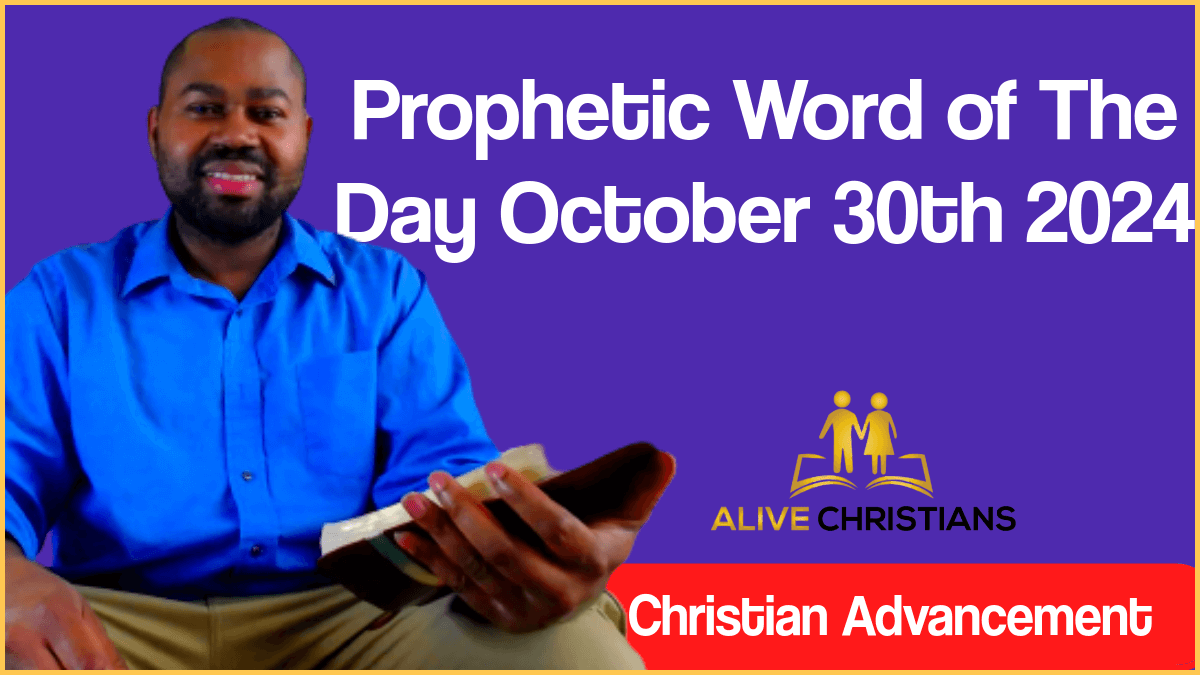
The prophetic word for the day - 30th October, 2024
How Do You Know When God Talks To You - (Ways To Know For Sure)
As I sought the Lord in my spirit, I sensed that we are to pray for a fresh wind of His Spirit; a fresh wind of His Spirit to refresh us. Just as a scripture in the book of Psalm says that the Lord restores our souls, so this fresh wind will bring about a time of refreshing and restoration to us individually and corporately as The Body of Christ.

You know, sometimes you can get so caught up with the work, so caught up with ministry, so caught up with doing the things that God wants you to do.
Watch Video Of The Prophetic Word For Today
Sometimes you can get so caught up with the business that you don't take the time to restored or to be cleaned and refreshed, because when you're doing the work of ministry or business and so forth, you're in the trenches.
And a lot of stuff can affect you, and it can have a draining effect on you. But when the Lord brings this refreshing of The Spirit like water, that washes over you, the dirt, grime and dross are washed away. As the scripture says in Proverbs, 25 verses 4-5, when we take away the dross from the silver, it shall come forth a vessel for the finer.
Likewise, when the wicked are removed from before the king, and I'm paraphrasing here, then his throne will be established in righteousness.
And this is what the Lord wants to do with this refreshing. He wants to bring about the changes that are necessary in order for you to arise.
Verse of the Day
Proverbs 25:4–5 (KJV)
Take away the dross from the silver, and there shall come forth a vessel for the finer.
Take away the wicked from before the king, and his throne shall be established in righteousness.
Removing What Corrupts So God’s Plan Can Be Established
Proverbs 25:4–5 reveals a principle that governs both personal transformation and leadership stability: what is removed determines what can be established. God does not build His purposes on unrefined material. Before something valuable is fully revealed, something impure must be dealt with.
The imagery begins with silver. Silver does not lose its value because of dross-it loses its usefulness. The impurity must be separated, not ignored. In the same way, God’s plan for your life today may not require something new to be added, but something unhealthy to be removed.
Through the Lord Jesus, refinement is not punishment; it is preparation.
1. “Take Away the Dross” - God’s Plan Begins With Refinement
Dross is not obvious treasure-it is hidden impurity mixed into something valuable. This matters, because dross often represents things that coexist comfortably with good intentions: wrong motivations, subtle pride, unresolved bitterness, or misplaced trust.
God’s instruction is direct: take it away. Refinement is intentional. Silver does not refine itself. God’s plan for today includes allowing Him to expose what hinders clarity and fruitfulness.
This process may feel uncomfortable, but it is purposeful. Refinement does not diminish value-it reveals it.
Application for today:
Ask God to show you anything that is dulling your spiritual clarity. Be willing to let go of attitudes, habits, or influences that no longer serve His purpose in your life.
2. Purity Produces Purpose
The result of refinement is clear: a vessel for the finer. God is not merely removing dross to clean the silver; He is preparing it for higher use. A refined vessel is suitable for honor, responsibility, and visibility.
This speaks directly to destiny. God’s plan advances when character and calling are aligned. Through the Lord Jesus, preparation always precedes promotion. God values readiness more than speed.
Many delays are not denials-they are refinements.
Application for today:
Instead of asking God to move faster, ask Him to prepare you more fully. Trust that refinement is positioning you for what comes next.
3. Removal Precedes Establishment
Verse 5 shifts from metallurgy to governance, but the principle remains the same. Take away the wicked from before the king, and his throne shall be established. Stability follows discernment.
God shows us that what surrounds authority shapes outcomes. A throne is not weakened by external opposition as much as by internal corruption. God’s plan for leadership-whether in a home, ministry, workplace, or nation-depends on who has influence.
Through the Lord Jesus, righteousness establishes authority that lasts.
Application for today:
Examine who or what has influence over your decisions. Are those influences strengthening righteousness or compromising it? Adjust accordingly.
4. God Establishes What Is Aligned
The word established speaks of permanence. God does not build temporarily. When righteousness governs, stability follows. This applies personally as well as corporately. When your inner life is aligned, your outer life becomes steadier.
God’s plan for today may involve pruning relationships, habits, or mindsets that undermine righteousness. This is not loss-it is protection.
Through the Lord Jesus, alignment brings peace, clarity, and durability.
Application for today:
Invite God to reorder priorities where needed. Make choices today that favor righteousness over convenience.
5. Refinement Is an Act of Mercy
Proverbs 25:4–5 shows us that removal is not rejection. God refines because He intends to establish. Leftover dross would weaken the vessel; unchecked wickedness would destabilize the throne.
God’s plan is merciful because it addresses issues before they cause collapse.
Through the Lord Jesus, correction is evidence of care.
Application for today:
Receive correction without resistance. What God is removing today is making room for strength tomorrow.
Early biblical voices consistently understood this passage as a principle of divine order. Ambrose of Milan taught that righteousness cannot stand where corruption is tolerated, likening moral purification to the strengthening of authority. Anselm of Canterbury emphasized that right order-both inward and outward-is essential for anything God establishes to endure. Richard Baxter later echoed this truth pastorally, warning that unaddressed corruption weakens both souls and communities, while godly correction preserves peace and longevity.
Historical Scholarly Support on Proverbs 25:4–5 (Pre-1800)
| Scholar | Dates | Emphasis | Summary of View |
|---|---|---|---|
| Origen of Alexandria | c. 184–253 | Spiritual purification | Origen viewed refinement as the soul being prepared for divine use. |
| Basil the Great | 330–379 | Moral clarity | Basil emphasized removal of inner corruption to reflect God’s image. |
| Ambrose of Milan | 339–397 | Purity and authority | Ambrose taught that righteousness stabilizes leadership. |
| Isidore of Seville | c. 560–636 | Wisdom through correction | Isidore linked refinement to wisdom and sound judgment. |
| Anselm of Canterbury | 1033–1109 | Order and righteousness | Anselm emphasized right order as foundational to stability. |
| Hugh of St. Victor | 1096–1141 | Inner discipline | Hugh saw purification as preparation for higher calling. |
| Nicholas of Lyra | c. 1270–1349 | Literal and moral sense | Lyra connected purification to both personal and civic righteousness. |
| Heinrich Bullinger | 1504–1575 | Reform through removal | Bullinger stressed removing corruption to restore godly order. |
| William Perkins | 1558–1602 | Practical holiness | Perkins taught that holiness establishes enduring spiritual authority. |
| Richard Baxter | 1615–1691 | Reform of heart and community | Baxter emphasized correction as necessary for lasting peace. |
Watch Video Of The Prophetic Word For Today

He wants to bring about the changes that are necessary for you to step into your place of authority in the realm that He has given to you.
And so this day is a day for you to pray for the fresh wind of the Holy Ghost so that you can be refreshed to do, as the Lord would have you do, without the weight of the work of yesteryear weighing on your shoulders. And this is the word of the Lord to you, in Jesus mighty Name.

Primary Theological Sources
Origen, Commentary on Proverbs; On First Principles
Basil the Great, Homilies on the Psalms; Hexaemeron
Ambrose of Milan, On Duties of the Clergy
Isidore of Seville, Etymologies
Anselm of Canterbury, Proslogion; Cur Deus Homo
Hugh of St. Victor, Didascalicon
Nicholas of Lyra, Postillae Perpetuae
Heinrich Bullinger, Decades
William Perkins, A Treatise of Conscience
Richard Baxter, The Saints’ Everlasting Rest