
Table of Contents
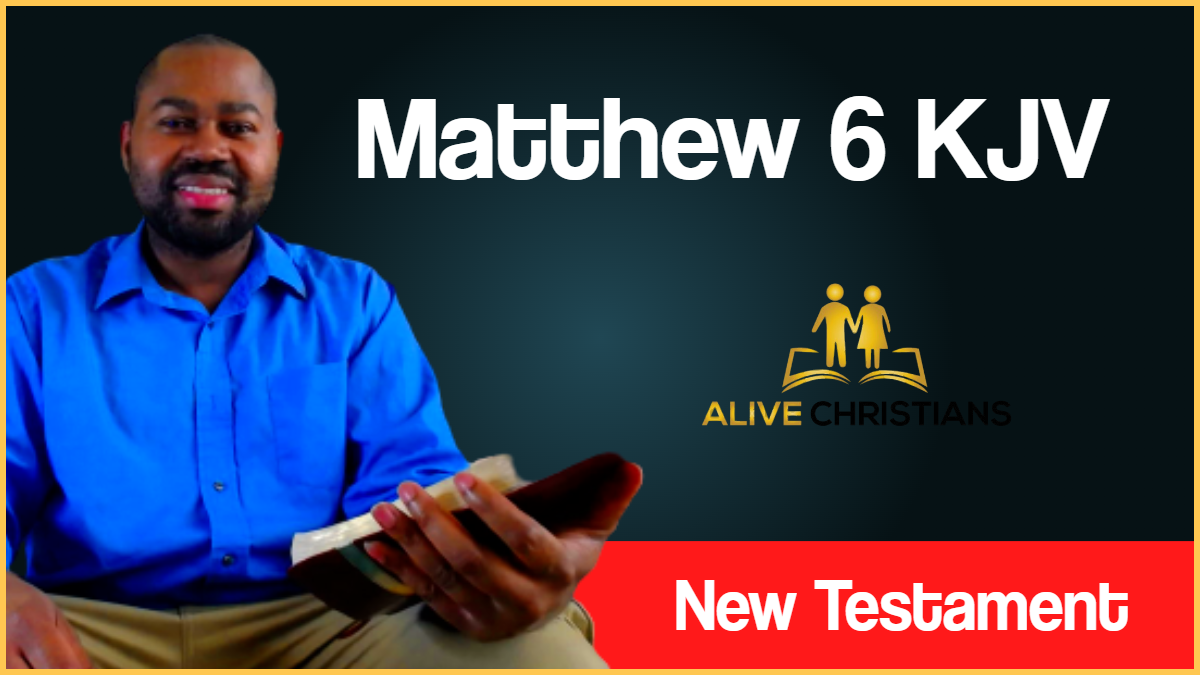
Matthew 6 KJV Audio (Above)
King James Version, Holy Bible
1 Take heed that ye do not your alms before men, to be seen of them: otherwise ye have no reward of your Father which is in heaven.
2 Therefore when thou doest thine alms, do not sound a trumpet before thee, as the hypocrites do in the synagogues and in the streets, that they may have glory of men. Verily I say unto you, They have their reward.
3 But when thou doest alms, let not thy left hand know what thy right hand doeth:
4 That thine alms may be in secret: and thy Father which seeth in secret himself shall reward thee openly.
5 And when thou prayest, thou shalt not be as the hypocrites are: for they love to pray standing in the synagogues and in the corners of the streets, that they may be seen of men. Verily I say unto you, They have their reward.
6 But thou, when thou prayest, enter into thy closet, and when thou hast shut thy door, pray to thy Father which is in secret; and thy Father which seeth in secret shall reward thee openly.
Matthew Chapter 6 (New Testament)
7 But when ye pray, use not vain repetitions, as the heathen do: for they think that they shall be heard for their much speaking.
8 Be not ye therefore like unto them: for your Father knoweth what things ye have need of, before ye ask him.
9 After this manner therefore pray ye: Our Father which art in heaven, Hallowed be thy name.
10 Thy kingdom come, Thy will be done in earth, as it is in heaven.
11 Give us this day our daily bread.
12 And forgive us our debts, as we forgive our debtors.
Matthew Chapter 6 (New Testament)
13 And lead us not into temptation, but deliver us from evil: For thine is the kingdom, and the power, and the glory, for ever. Amen.
14 For if ye forgive men their trespasses, your heavenly Father will also forgive you:
15 But if ye forgive not men their trespasses, neither will your Father forgive your trespasses.
16 Moreover when ye fast, be not, as the hypocrites, of a sad countenance: for they disfigure their faces, that they may appear unto men to fast. Verily I say unto you, They have their reward.
17 But thou, when thou fastest, anoint thine head, and wash thy face;
18 That thou appear not unto men to fast, but unto thy Father which is in secret: and thy Father, which seeth in secret, shall reward thee openly.
19 Lay not up for yourselves treasures upon earth, where moth and rust doth corrupt, and where thieves break through and steal:
20 But lay up for yourselves treasures in heaven, where neither moth nor rust doth corrupt, and where thieves do not break through nor steal:
21 For where your treasure is, there will your heart be also.
22 The light of the body is the eye: if therefore thine eye be single, thy whole body shall be full of light.
23 But if thine eye be evil, thy whole body shall be full of darkness. If therefore the light that is in thee be darkness, how great is that darkness!
24 No man can serve two masters: for either he will hate the one, and love the other; or else he will hold to the one, and despise the other. Ye cannot serve God and mammon.
25 Therefore I say unto you, Take no thought for your life, what ye shall eat, or what ye shall drink; nor yet for your body, what ye shall put on. Is not the life more than meat, and the body than raiment?
26 Behold the fowls of the air: for they sow not, neither do they reap, nor gather into barns; yet your heavenly Father feedeth them. Are ye not much better than they?
27 Which of you by taking thought can add one cubit unto his stature?
28 And why take ye thought for raiment? Consider the lilies of the field, how they grow; they toil not, neither do they spin:
29 And yet I say unto you, That even Solomon in all his glory was not arrayed like one of these.
30 Wherefore, if God so clothe the grass of the field, which to day is, and to morrow is cast into the oven, shall he not much more clothe you, O ye of little faith?
31 Therefore take no thought, saying, What shall we eat? or, What shall we drink? or, Wherewithal shall we be clothed?
32 (For after all these things do the Gentiles seek:) for your heavenly Father knoweth that ye have need of all these things.
33 But seek ye first the kingdom of God, and his righteousness; and all these things shall be added unto you.
34 Take therefore no thought for the morrow: for the morrow shall take thought for the things of itself. Sufficient unto the day is the evil thereof.
| Greek Word + Transliteration | Verse + Snippet | Meaning | Scholarly Notes |
|---|---|---|---|
| ἐλεημοσύνη - eleēmosynē | Verse 1 - “do not your alms before men…” | “Almsgiving,” charity. | Eleēmosynē (“charity”) denotes compassionate giving (“almsgiving”). Jesus warns against performance-driven righteousness. The term emphasizes mercy as sincere devotion. - Joseph Henry Thayer, Greek-English Lexicon (1889) |
| ταμεῖον - tameion | Verse 6 - “…enter into thy closet…” | “Inner room,” private chamber. | Tameion (“inner room”) signifies secrecy in prayer (“private room”). Jesus directs devotion toward the Father, not spectators. The term reinforces sincerity in spiritual disciplines. - Richard C. Trench, Synonyms of the New Testament (1896) |
| προσεύχομαι - proseuchomai | Verse 6 - “…pray to thy Father…” | “Pray,” offer prayer. | Proseuchomai (“to pray”) indicates reverent communion (“pray”). Jesus stresses relational approach to God. The term frames prayer as trustful dependence. - Philip Schaff, Commentary on Matthew (1882) |
| ἁγιάζω - hagiazō | Verse 9 - “Hallowed be Thy name…” | “Sanctify,” regard as holy. | Hagiazō (“to sanctify”) expresses reverence (“hallow”). The petition asks that God’s character be honored among His people. The term reflects covenant worship. - Franz Delitzsch, Biblical Commentary (1884) |
| ἐπιούσιος - epiousios | Verse 11 - “…give us this day our daily bread…” | “Daily,” necessary for the day. | Epiousios (“daily/necessary”) conveys ongoing dependence (“daily”). It is unique to the Lord’s Prayer. The term stresses trust in God’s provision. - Joseph Henry Thayer, Lexicon (1889) |
| ἀφίημι - aphiēmi | Verse 12 - “…forgive us our debts…” | “Forgive,” release. | Aphiēmi (“to forgive”) means release from obligation (“forgive”). Forgiveness reflects God’s mercy. The term stresses relational reconciliation. - Richard Trench, Synonyms (1896) |
| πειρασμός - peirasmos | Verse 13 - “…lead us not into temptation…” | “Testing,” trial. | Peirasmos (“testing”) signifies spiritual proving (“temptation/trial”). It recognizes human fragility. The term expresses desire for divine protection. - Philip Schaff, Church History (1890) |
| ὀλιγόπιστος - oligopistos | Verse 30 - “…O ye of little faith…” | “Little in faith,” weak belief. | Oligopistos (“little-faith”) rebukes anxiety (“small faith”). Jesus contrasts divine care with human worry. The term invites trust in providence. - Thayer, Lexicon (1889) |
| πρωτοζητέω - prōtozēteō | Verse 33 - “seek ye first the kingdom…” | “Seek first,” prioritize. | Prōtozēteō (“to seek first”) demands supreme priority (“seek foremost”). God’s kingdom is placed above material need. The term defines discipleship orientation. - Richard Trench, Synonyms (1896) |
| μάμωνας - mamōnas | Verse 24 - “…cannot serve God and mammon.” | “Wealth,” riches. | Mamōnas (“riches”) symbolizes idolatrous attachment to wealth (“mammon”). Jesus presents materialism as rival lordship. The term reveals spiritual danger. - Franz Delitzsch, Biblical Commentary (1884) |
Scholars on Hidden Piety and Trust in the Sermon on the Mount (15th–19th Century)
| Scholar (Institution & Dates) | Work | View |
|---|---|---|
| Nicholas of Lyra (University of Paris, c. 1270–1349) | Postillae Perpetuae | He explains that Christ warns against showing off religious acts. True almsgiving, prayer, and fasting come from a pure heart and are done privately before God. |
| Desiderius Erasmus (University of Paris / Cambridge, 1466–1536) | Paraphrasis in Evangelium | Erasmus reads this passage as urging interior righteousness, sincerity in devotion, and trust in God rather than seeking human praise. |
| Martin Luther (University of Wittenberg, 1483–1546) | Church Postil | Luther emphasizes that acts done for reputation are worthless. Real faith expresses itself in private charity and prayer, not public display. |
| John Calvin (University of Paris / Orléans, 1509–1564) | Commentary on a Harmony of the Evangelists | Calvin argues that Christ exposes human vanity in religion. Genuine devotion seeks only the approval of the Father. |
| Francis de Sales (University of Padua, 1567–1622) | Introduction to the Devout Life | He stresses modesty in devotion. Quiet giving, private prayer, and humble fasting are the true marks of piety. |
| Hugo Grotius (University of Leiden, 1583–1645) | Annotationes in Novum Testamentum | Grotius interprets the passage as universal ethics: avoid ostentation and rely on God’s provision. |
| Matthew Poole (University of Oxford, 1624–1679) | Synopsis Criticorum | Poole notes that Christ commands believers to avoid outward show and trust entirely in God for daily needs. |
| Matthew Henry (Christ Church, Oxford, 1662–1714) | Exposition of the Old and New Testament | Henry presents the teaching as a guide for secret devotion, including charity, prayer, and fasting, along with freedom from anxiety. |
| Johann Albrecht Bengel (University of Tübingen, 1687–1752) | Gnomon Novi Testamenti | Bengel views almsgiving, prayer, and fasting as a structured triad that forms the believer’s inner spiritual life. |
| August Neander (University of Berlin, 1789–1850) | Life of Jesus Christ | Neander interprets the passage as Christ’s call to authentic morality rather than empty ritual. |
| Friedrich Tholuck (University of Halle, 1799–1877) | Die Bergpredigt | Tholuck highlights sincerity in hidden devotion and radical trust in God that replaces anxious striving. |
| Joseph Addison Alexander (Princeton Theological Seminary, 1809–1860) | The Sermon on the Mount | Alexander treats the teaching as a precise guide against self-advertising in religious acts. |
| Charles Hodge (Princeton University, 1797–1878) | Commentary on the Gospels | Hodge sees the passage as both a rebuke to ostentation and a reassurance of God’s providential care |
Matthew Chapter 6
One devotional message from Matthew chapter 6 is on the importance of prioritizing our devotion to God above all else. In verses 31-33, Jesus says:
"So do not worry, saying, ‘What shall we eat?’ or ‘What shall we drink?’ or ‘What shall we wear?’ For the pagans run after all these things, and your heavenly Father knows that you need them. But seek first his kingdom and his righteousness, and all these things will be given to you as well."
The lesson we must learn from this is that when we make God our top priority, everything else falls into place. We can trust Him to provide for our needs, and we can rest in the knowledge that He loves us and has our best interests at heart.
In conclusion, let us remember to seek God first in all that we do, and trust Him to take care of us. Let us lay aside our worries and anxieties, and focus on living for Him. And let us pray that we will always put God first, and that He will guide us and provide for us every step of the way.
Prayer points:
l Pray for a deeper understanding of the importance of seeking God's kingdom first
l Pray for the strength and discipline to prioritize our devotion to God above all else
l Pray for the faith to trust God to provide for our needs, and the courage to lay aside our worries and anxieties
What's Next? See our Inspirational Motivational Bible Quotes Today